
How Did an Ancient Climate on Mars Trap Sulfates?
22 October 2026
The Curiosity rover and its Franco-American ChemCam instrument mapped a thick formation of sulfate nodules, enabling an international team—including researchers from LGL-TPE—to reveal a succession of wet and dry climates on Mars dating back more than 3.5 billion years. This climate evolution is far from a monotonous aridification and resembles Earth’s semi–arid regions.
Image shown here: Rocks analyzed by ChemCam (crosshairs) displaying textures with (d–i) and without sulfate nodules (a–c). Credits: NASA / JPL–Caltech / LANL / CNES / CNRS / IRAP / IAS / LPG
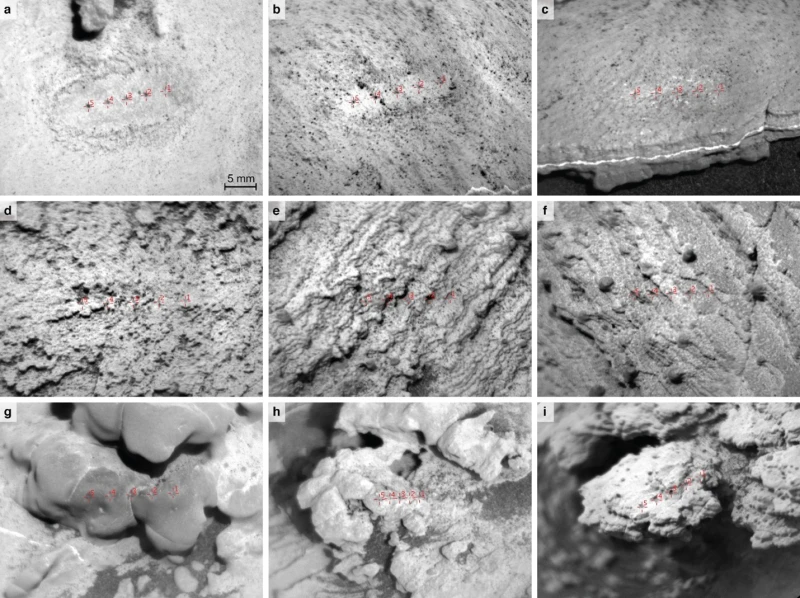
On a 6-kilometer-high sedimentary massif, the Curiosity rover is traversing layers rich in sulfate salts. Using data from the Franco-American ChemCam instrument, an international team led by William Rapin has shown that these sulfates formed within sediments 200 meters thick during climate fluctuations more than 3.5 billion years ago. These findings, published in the Journal of Geophysical Research: Planets, indicate that the salts crystallized, forming nodules, each time the water table evaporated.
ChemCam has enabled high-resolution mapping of fine sedimentary structures exposed up to 1.5 km around the rover, revealing traces of ancient dune fields crisscrossed by ephemeral rivers. The instrument also analyzes the chemical composition at each of the rover’s stops, revealing a large population of nodules rich in calcium and magnesium sulfates. Mapping of these nodules indicates they formed through evaporation when the water table was close to the surface.
Until now, orbital data suggested a gradual disappearance of water from the surface of Mars and a transition to a strictly arid climate. The new Curiosity data presented here, however, reveal a prolonged succession of dry and wet climates, as indicated by the sulfate nodules. This study thus proposes a new model for the accumulation of sulfates on Mars, linked to surface climates rather than to weathering by deep, late-stage groundwater.
This model resembles semi–arid regions on Earth, where dune fields are subject to alternating wet and dry periods. Mars, like Earth, may therefore have experienced rapid climatic fluctuations. Martian sulfates are thus not merely markers of the end of wet environments, but are rather associated with the presence of water near the surface.
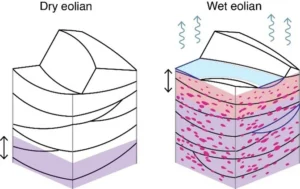
Model of sulfate formation (red) in a dune field, based on past climates when the water table (purple) was closer to the surface, allowing for evaporation