
A revised early Jurassic to Albian chronology for dinosaur evolution in tropical Asia
This post offers a behind-the-scenes look at the study ‘A revised early Jurassic to Albian chronology for dinosaur evolution in tropical Asia’ published in October 2026 in Communications Earth & Environment, featuring Jeremy Martin, CNRS researcher at LGL-TPE.
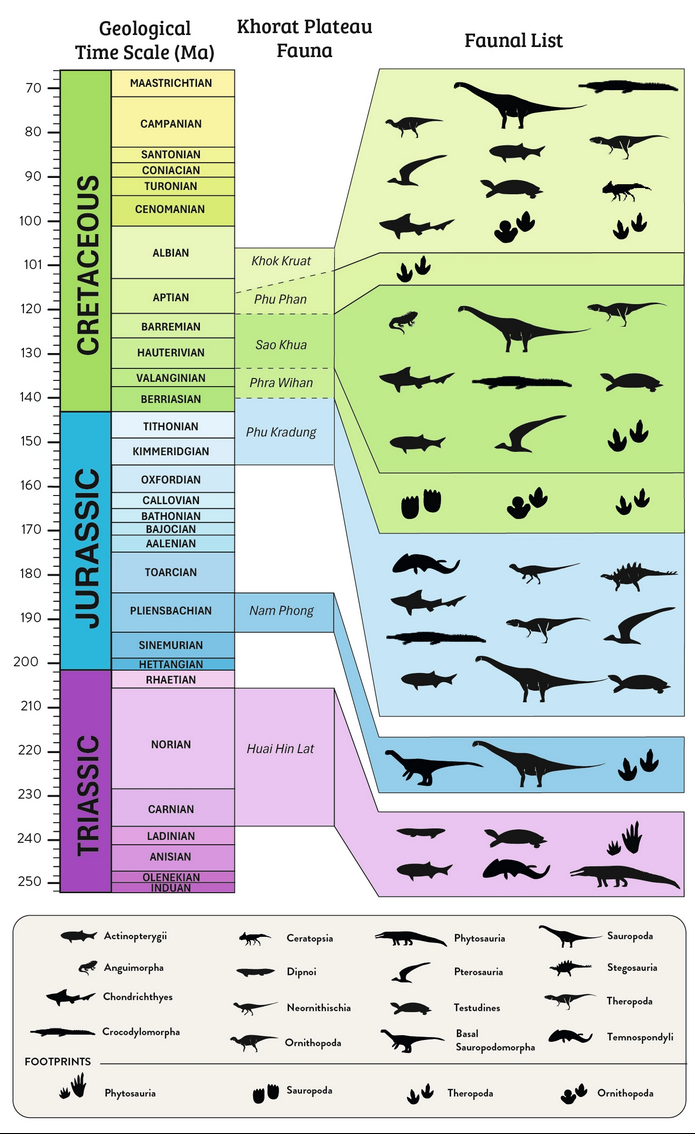
For more than 50 years, dinosaur fossils have been discovered throughout Thailand. The most prolific location for dinosaur fossil is the Khorat Plateau, where numerous geological units, covering a significant part of the Mesozoic (the era spanning from 252 to 66 million years ago), yield new fossils of various age every year (see, for example, some of the fossils already published this year, here and here). However, these dinosaurs and their associated fauna typically exhibit broad temporal ranges and thus do not provide any precise information about their age; moreover, no volcanic ash layers (which could be dated with geochronological techniques) have been identified within these deposits. The chronological framework for the dinosaurs of the Khorat Plateau has thus largely relied on approximate age estimations. Without a clear chronological framework, comparing the dinosaurs of Thailand with other dinosaur fauna has always been complex.
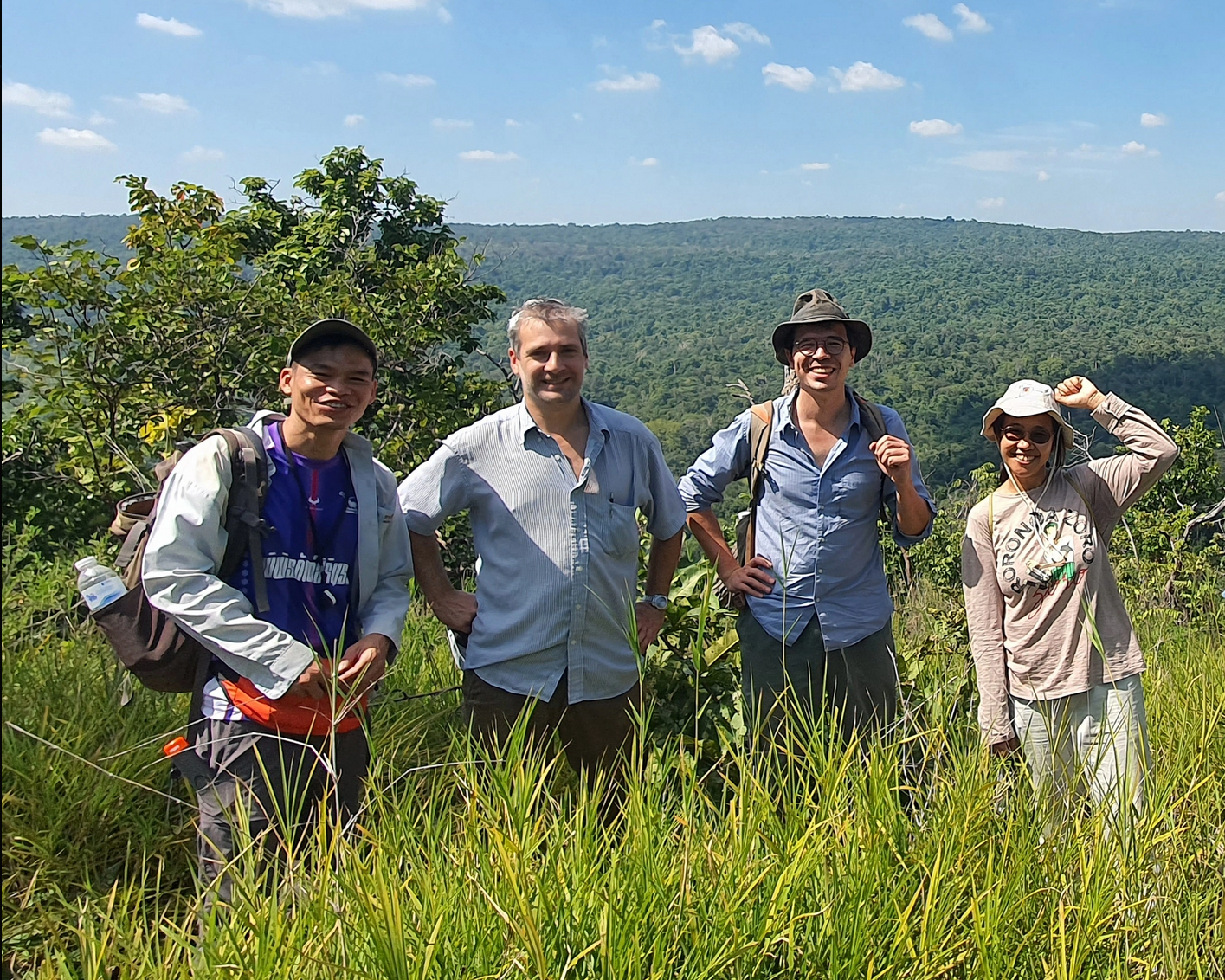
From left to right: Ditbanjong, Martin, Licht, and Chanthasit in the field
on the Khorat Plateau in 2022.
Beyond the clear need for tighter age constraints, this paper is actually born from three causes: a long-term paleontological collaboration between French and Thai paleontologists, a transatlantic move, and a 4-days fieldtrip after the 2022 IPC conference.
The Thai-French research team pioneered dinosaur excavation efforts in Thailand in the late 1970’s and has maintained this partnership over time (with iconic discoveries, such as the earliest sauropods and tyrannosaurids on record at their time of discovery). Jeremy Martin, Phornphen Chanthasit, Komsorn Lauprasert and Supanut Bhuttarach perpetuate this long-standing collaboration since the late 2000’s. Martin and Chanthasit met in 2007 while being Ph.D. students at the same laboratory at the University de Lyon, working on Thai Mesozoic material (Martin specialized in crocodiles and Chanthasit in dinosaurs). Meanwhile, Ditbanjong was studying Thai stratigraphy at the University de Lille 1. They have been working together since then, notably on refining the fossil record of crocodylomorphs (see, for example, here and here).