
MSCA SPIDER
Slab Plume Interactions in Deep Earth Regions
Funding : ERC-MSCA, 242260.56 € [HORIZON-MSCA-2024-PF-01-01]
Coordinators : Ritabrata Dasgupta (PI), Maëlis Arnould (Primary Supervisor), Maxim Ballmer (Secondement).
Main partner : Lyon 1 Université
Secondment partner :
- University College London (UCL), UK
Duration : 2025 – 2027
Summary of the project
I will decipher the nature and dynamics of slab-plume interactions using whole-mantle convection models to unravel mantle rheology, its effects on magmatism, deformation and climate, as it is still not well constrained. Mantle plumes and subducting slabs are integral parts of mantle convection. Plumes consist of narrow conduits carrying hot and light material from the Core-Mantle Boundary (CMB) to the surface, where they are responsible for hotspot (i.e., intraplate) magmatism and surface uplift. Cold and dense subducting slabs sink from the surface to the deeper mantle, driving plate tectonics and causing surface depression. Seismic tomography provides images of the present-day geometry of plumes and slabs and shows that both exhibit complex 3D shapes, indicative of their deformation history through multiple interactions with their environment. In particular, plumes and slabs located in close proximity to one another often show very intricate shapes, suggesting an influence on each other’s dynamics. For example, the Tonga slab/Samoa plume in the West Pacific, and the Farallon slab/Yellowstone plume below North-America show very distinct shapes: while the Samoan plume seems deflected by the Tonga slab, the Yellowstone plume penetrates through the Farallon slab up to the surface. This striking geometrical dichotomy is likely indicative of mantle properties (strength, rheology, composition) and dynamics, but quantitative studies are lacking. Indeed, most numerical models have addressed either subduction or plume dynamics in isolation. Existing studies dismiss important observations such as slab-plume shapes and fail to constrain the factors controlling slab-plume interactions.
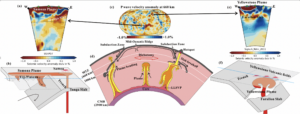
Graphical representation of the diversity of slab-plume interactions, synthesized by a dichotomy between two end-member cases (c). In case of the Tonga subduction system, the Samoan plume is deflected by the slab and gets entrapped within the mantle wedge as seen from seismic tomography (a) and a schematic representation (b). For Yellowstone, the plume penetrates the Farallon slab to create a slab window before reaching shallow depths and generating volcanism, as shown by tomography (e) and the schematic diagram (f). The top central figure (c) shows worldwide P-wave velocity anomalies at 660 km depth that reveal zones of intense plume activity adjacent to subduction zones (Tonga and Farallon). The three black dotted lines on (a) and (e) represent the 410, 660 and 1000 km-depth discontinuities. The blue dotted lines on (b) and (f) show the surface location of the corresponding 2D tomographic sections.