Observing the Earth's interior using neutrinos
What do seismologists and physicists have in common?
While seismic imaging has revealed the complex structure of the Earth’s interior in ever-greater detail, its interpretation in terms of thermochemical heterogeneities remains ambiguous when based solely on seismic velocities. In this context, we propose to explore atmospheric neutrinos as a complementary probe of the Earth’s interior.
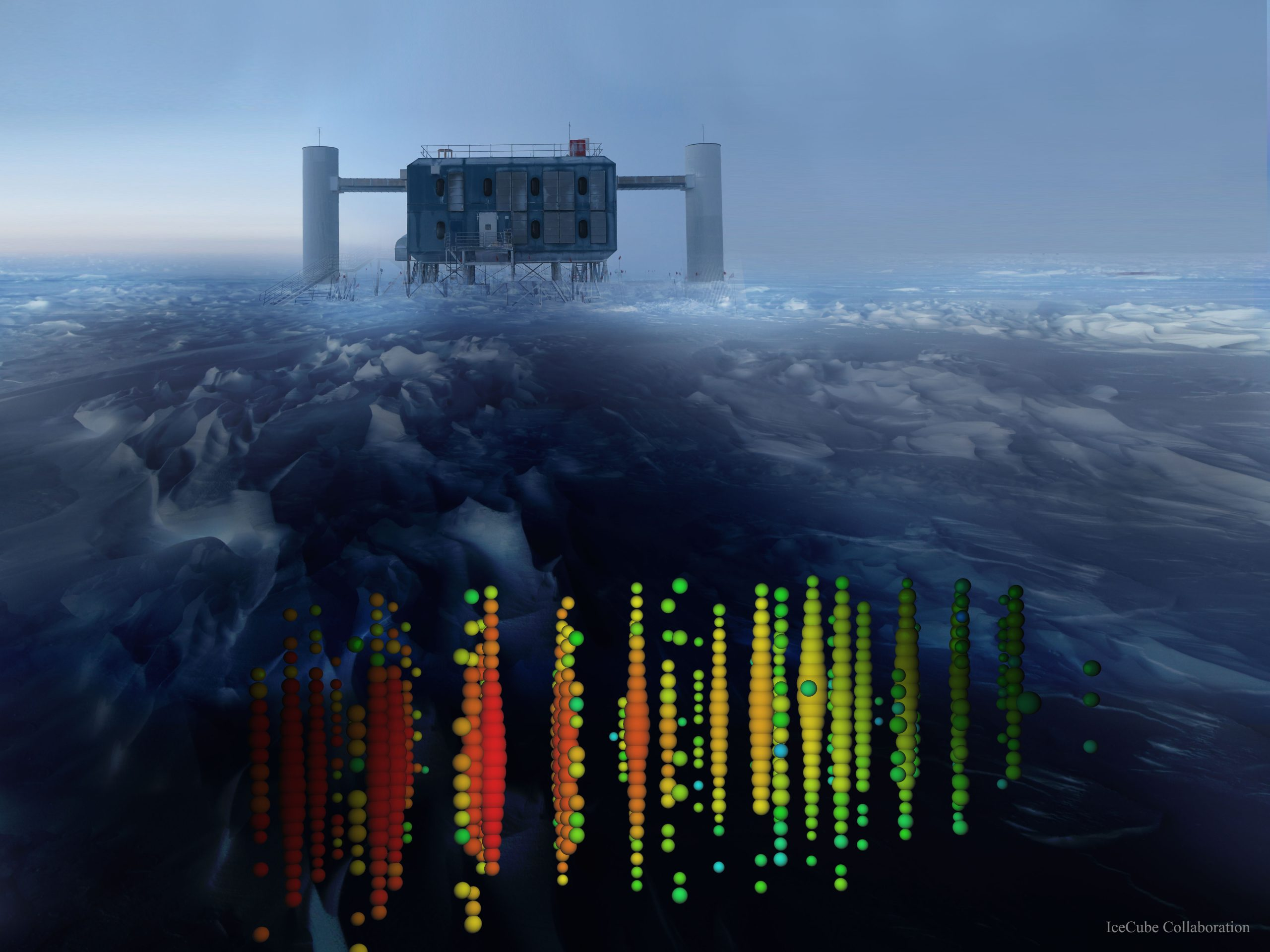
The IceCube facilities sits at the South Pole above an array of photodetectors, drawn into the image besides. @IceCube COllaboration, U. Wisconsin, NSF
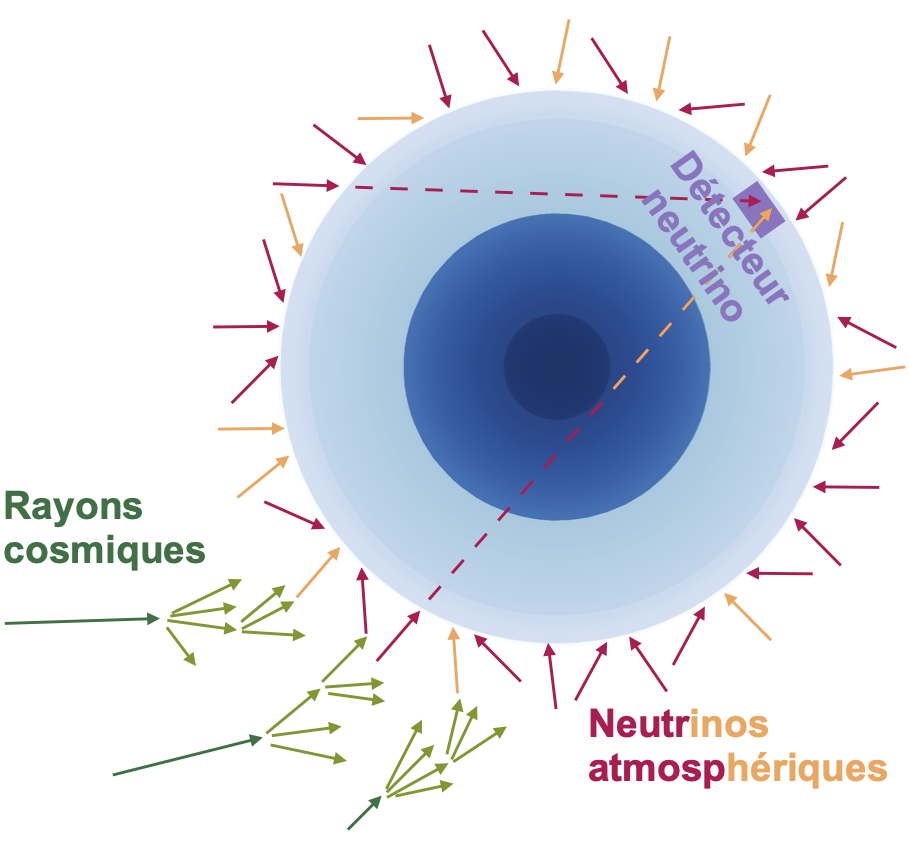
Continuously produced by the interactions of cosmic rays in the atmosphere, atmospheric neutrinos pass through the planet almost unimpeded, while undergoing “flavor” oscillations influenced by the electron density along their paths. Since electron density depends on both mass density and chemical composition, neutrino observations provide insight into the properties of materials within the Earth.
In recent work, we establish the theoretical framework necessary to integrate neutrino oscillation measurements into a future joint inversion with seismic data, in order to better constrain the electron density of the Earth’s interior (Goos et al., 2026). In particular, we are able to calculate the impact of small perturbations in electron density on the expected neutrino rates, a step essential for inversion.
In our study, we show that next-generation neutrino detectors, such as KM3NeT/ORCA, Hyper-Kamiokande, and DUNE, will be sensitive to perturbations in the Earth’s electron density. These detectors exhibit, in particular, increased sensitivity to the mantle. This sensitivity could make it possible to distinguish variations in chemical composition.
Our group brings together expertise in seismology (N. Fuji (IPGP), S. Durand (LGL-TPE)), geodynamics (E. Mittelstaedt (University of Idaho), Y. Deniz (University of Idaho)), neutrino physics (I. Goos (IPGP), V. van Elewick (APC), J. Coelho (APC)), and inverse methods to develop new approaches for imaging the Earth’s interior.